

Incheon National University Research Team Led by Professor Han-Bo-Ram Lee Publication in World’s Premier Chemistry Journal 'JACS'
- NO
- 427861
- Date
- 2026-07-31
- modification day
- 2026-07-31
- Writer
- 홍보과 (032-835-9490)
- Count
- 635

From left: Professor Han-Bo-Ram Lee, Integrated M.S.-Ph.D. Student Kyung-Min Min
A research study led by Professor Han-Bo-Ram Lee's team from the Department of Materials Science and Engineering at Incheon National University (President Lee In-jae) has been published in the Journal of the American Chemical Society (JACS, Impact Factor: 15.7), one of the world's most prestigious chemistry journals. The study is drawing significant attention from academia and industry by fundamentally resolving interfacial oxidation, a critical barrier in the atomic layer deposition process of ruthenium—a promising interconnect material for next-generation semiconductors.
As semiconductor fabrication scales down to the nanometer regime, ruthenium has emerged as a strong candidate to replace traditional copper interconnects. However, conventional ruthenium deposition processes have relied heavily on strong oxidizing agents. This approach causes a critical side effect: it oxidizes the underlying substrate during early deposition stages, drastically increasing contact resistance. While alternative processes using molecular hydrogen or plasma were proposed, molecular hydrogen presented a high chemical reaction barrier that made high-purity ruthenium deposition difficult. Meanwhile, plasma processes suffered from recombination of reactive species before reaching the bottom of complex 3D structures, preventing uniform film growth.
To overcome these limitations, Professor Lee's team adopted an innovative approach by introducing atomic hydrogen—generated by splitting molecular hydrogen—as a reactant. The team designed a process to stably supply atomic hydrogen using a hot-wire system. This atomic hydrogen dramatically lowers the decomposition barrier of the ruthenium precursor, effectively removing organic ligands from the precursor even at a low deposition temperature of 100 °C. The team fully elucidated this chemical mechanism both theoretically and experimentally.
Furthermore, the team demonstrated the potential to expand this technique to area-selective atomic layer deposition (ASD), a next-generation micro-patterning technology. This solidifies a advanced patterning method that selectively deposits ruthenium thin films only on targeted surfaces of semiconductor devices. The study proved that by re-injecting a surface inhibitor layer, unwanted growth on non-target areas is completely prevented, allowing precise ruthenium growth solely on the target area.
This research achievement holds immense academic value by providing a chemical guideline for uniformly depositing high-purity metal interconnects within complex nanoscale semiconductor architectures. Industrially, it is expected to serve as a pivotal outcome for securing competitive metal interconnect technologies that maximize yield and electrical performance in next-generation semiconductor manufacturing.
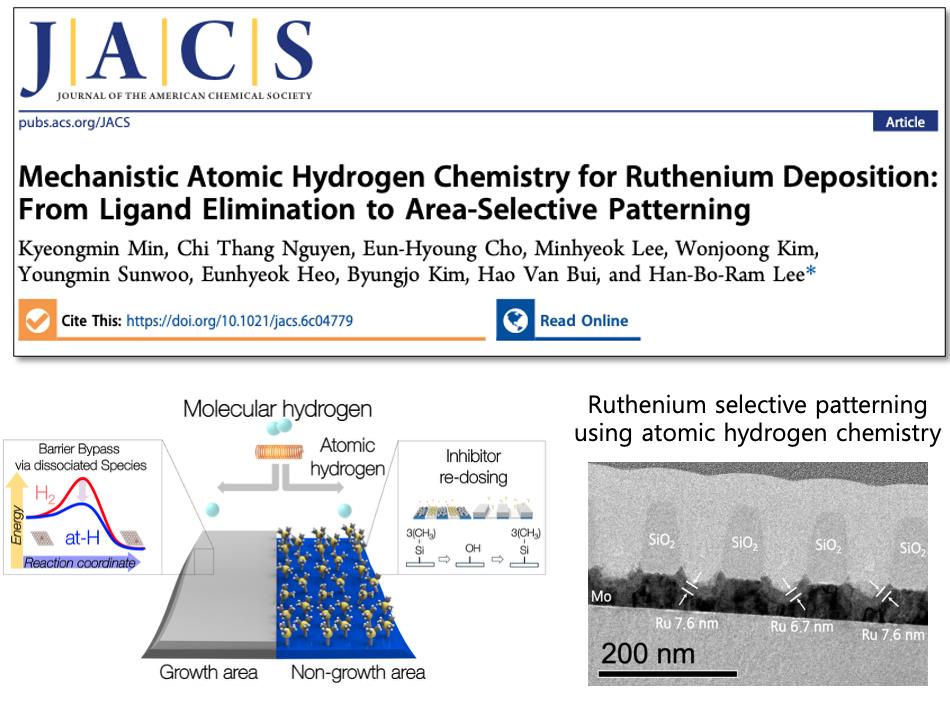
Demonstration of Area-Selective Atomic Layer Deposition of Ruthenium Using Atomic Hydrogen Chemical Mechanisms
- attached file