

Coastal Sediments Were Not the Ultimate Sink for Microplastics
- NO
- 427866
- Date
- 2026-07-31
- modification day
- 2026-07-31
- Writer
- 홍보과 (032-835-9490)
- Count
- 852
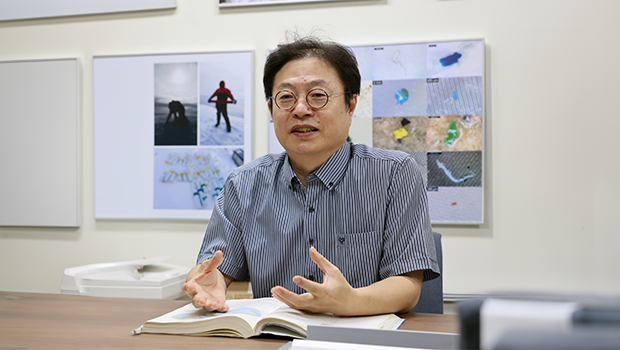
Professor Seung-Kyu Kim, Department of Marine Science
-Incheon National University research team demonstrates that in strong tidal environments, microplastics are likely to migrate back out to open seas
- Domestic researchers present a new interpretation challenging the conventional wisdom that "coastal sediments act as the final repository for microplastics"
❍ "Coasts Are Not the Final Destination for Microplastics"
A research team led by Professor Seung-Kyu Kim from the Department of Marine Science at Incheon National University announced that, based on a simultaneous survey of six water layers—from surface to bottom waters—and seabed sediments along the Incheon and Gyeonggi coasts, microplastics in coastal areas dominated by strong tides (high and low tides) are unlikely to accumulate in sediments long-term. Instead, they are continuously resuspended and are highly likely to transport to the open ocean via tidal flows and ocean currents.
The findings of this study were published in the July issue of the Journal of Hazardous Materials, a leading global academic journal in environmental science. Detailed research content can be found in the paper published in the journal (https://doi.org/10.1016/j.jhazmat.2026.142508).
❍ "Horizontal Spatial Distribution in Seawater and Seabed Sediments and Investigation Across Diverse Water Depths"
To date, most studies assumed that the majority of microplastics entering the ocean from rivers sink into coastal sediments, accumulating over the long term. Consequently, the degree of coastal sediment contamination has served as a primary basis for assessing the intensity of emissions or inflows into specific coastal zones and for establishing effective coastal environmental management strategies. However, this hypothesis remained insufficiently verified due to a lack of comprehensive studies simultaneously investigating surface water, the entire water column, and sediments across an entire coastal region.
The research team investigated the horizontal and vertical distribution of microplastics alongside various environmental and hydro-hydrological variables in the Incheon and Gyeonggi coastal bays—a representative macrotidal environment in the Yellow Sea located at the mouth of the Han River. Specifically, they examined surface water and seabed sediments across 11 stations. At two inner-bay and two outer-bay locations among them, they additionally surveyed five depth layers below the surface down to just above the seabed to evaluate microplastic distribution and coastal accumulation potential.
❍ "Tides Continuously Stir Up Microplastics... Coasts Are Transit Points, Not Reservoirs"
The investigation produced unexpected results. While concentration differences appeared at the surface depending on the area, microplastics were distributed almost uniformly throughout the water column from below the surface down to just above the seabed. This is interpreted as a result of strong tides repeating twice daily, continuously mixing the seawater and evenly dispersing microplastics throughout the entire water column.
Conversely, the distribution of microplastics within the sediment exhibited a completely different pattern compared to the seawater directly above it. Neither the concentrations nor the types of plastics detected matched; in some locations, sediment concentrations were high despite low microplastic concentrations in seawater, and vice versa. This indicates that microplastics settling into sediment are repeatedly resuspended and transported by tidal currents, failing to remain stably buried over the long term.
The research team also calculated the proportion of microplastic carbon relative to total organic carbon in the sediment (MP-C). The microplastic carbon proportion in sediment was found to be only about 0.03%, which is 10 to over 100 times lower than the values observed in the water column. This demonstrates that the capacity of coastal sediments to store microplastics long-term is far more limited than previously thought. Consequently, microplastics in coastal environments exist primarily suspended in water bodies where they easily disperse and migrate, rather than accumulating in long-term sediments.
❍ "Microplastic Management Strategies Must Shift"
This study presents important policy implications. Previously, it was believed that surveying the amount of microplastics accumulated in coastal sediments could accurately evaluate the pollution level of a marine area. However, in sea areas with strong tides like the Yellow Sea of Korea, sediment is highly likely to fail to reflect the actual current pollution status. Therefore, the research team suggested that future microplastic management policies require an integrated monitoring framework that surveys the entire water column alongside sediment assessments.
Professor Seung-Kyu Kim explained, "This study provides field observations demonstrating the possibility that coastal sediments are not the final destination for microplastics. Particularly in sea areas with strong tides like the Yellow Sea of Korea, microplastics can be continuously resuspended and transported to the open sea, necessitating a re-examination of conventional coastal accumulation concepts. However, since this study was limited to subtidal sediments, further research including intertidal sediments is needed."
He added, "Moving forward, research is required to elucidate the pathways and volumes through which microplastics enter the Incheon coast, how much migrates to the open ocean via coastal areas, and how this transport impacts marine ecosystems and global ocean circulation."
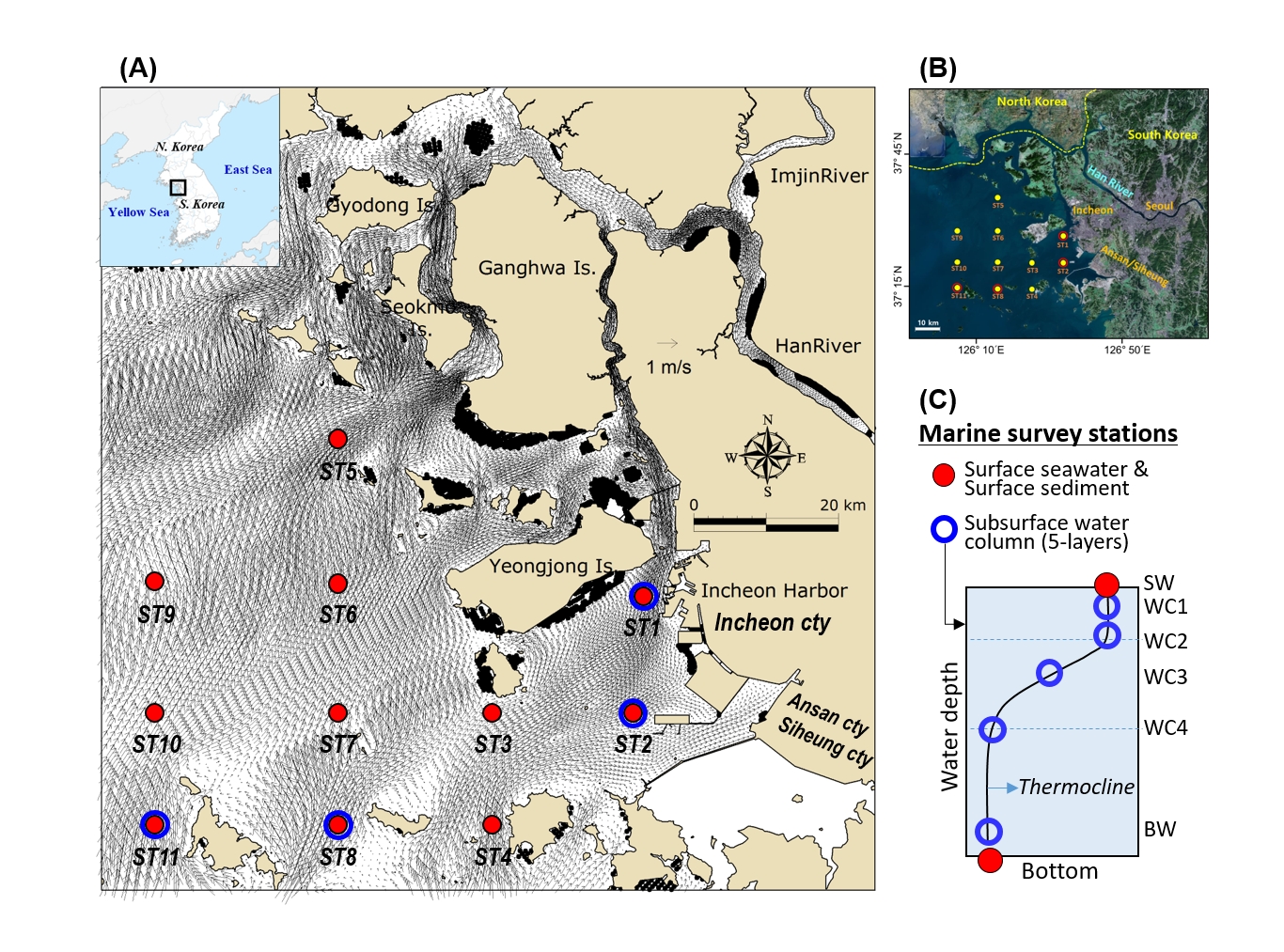
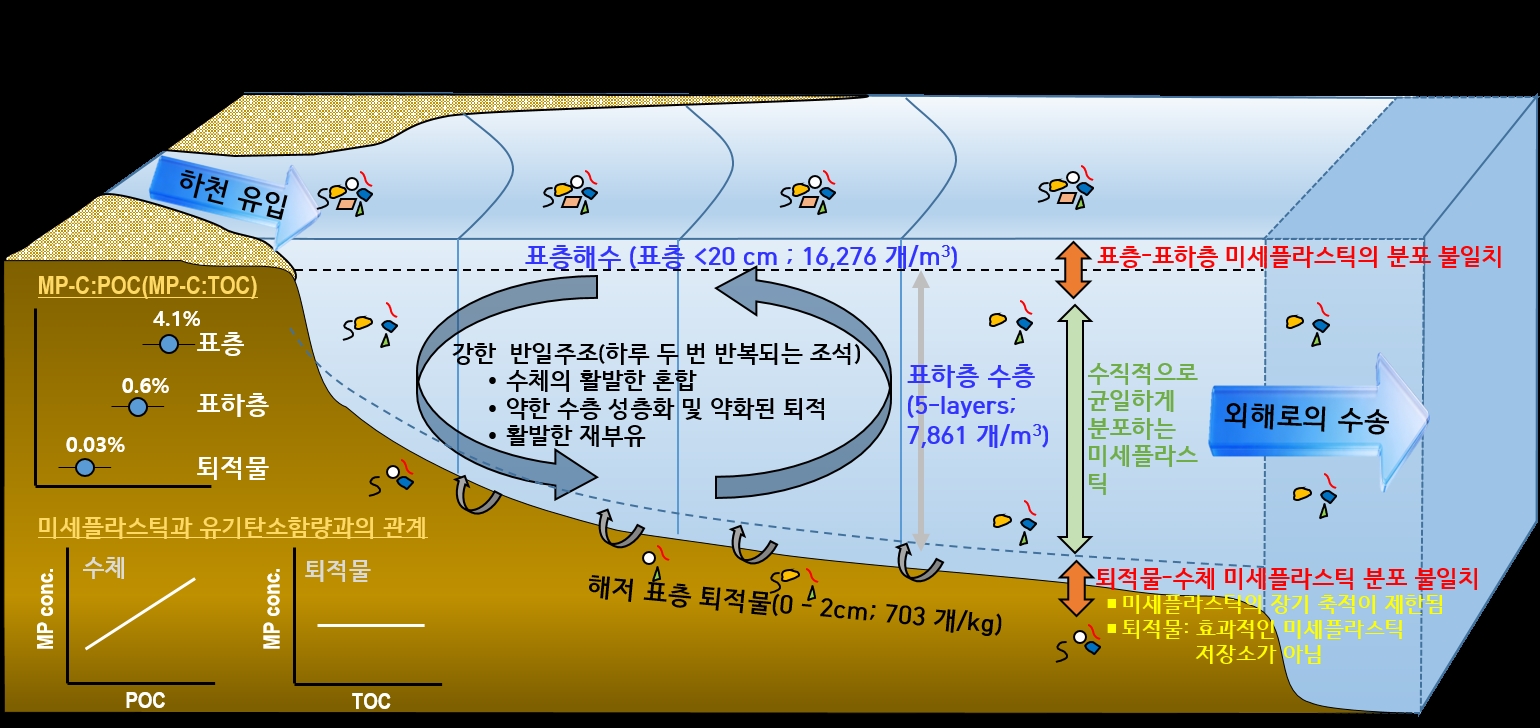
Sampling locations map for horizontal surveys of surface seawater and seabed sediment (A and B) and vertical seawater survey methodology (C) along the Incheon-Gyeonggi coast / Schematic diagram of microplastic distribution and transport patterns in a macrotidal estuarine-coastal system