
Incheon National University Professor Jun-Seob Kim Publishes Research Paper in Premier Academic Journal 'Signal Transduction and Targeted Therapy'
- NO
- 427863
- Date
- 2026-07-31
- modification day
- 2026-07-31
- Writer
- 홍보과 (032-835-9490)
- Count
- 855

Professor Jun-Seob Kim, Department of Nano-Bioengineering, Incheon National University
Tumor-derived extracellular vesicles (TEVs) secreted by cancer cells are well-known key mediators that facilitate tumor growth and immune evasion. Conventional therapeutic strategies have primarily focused on indiscriminately inhibiting or eliminating these TEVs. However, as it has been revealed that TEVs can also act as "immunogenic TEVs" that induce anti-tumor immunity depending on the context, the need for a more sophisticated regulatory strategy has emerged.
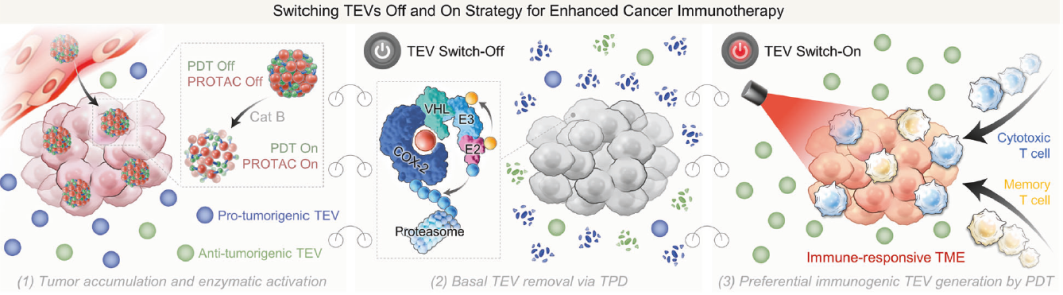
In this study, a research team led by Professor Jun-Seob Kim (Department of Nano-Bioengineering) at Incheon National University, through a joint research effort with teams from the Korea Institute of Science and Technology (KIST) and Sungkyunkwan University, developed 'EVOTAC'—a PROTAC-based nanostructure—and presented a novel therapeutic strategy that switches TEVs between "off" and "on" states. EVOTAC is activated in response to a cancer-cell-specific enzyme (Cathepsin B), initially selectively degrading COX-2 proteins to inhibit TEV generation. Subsequently, when immunogenic stress is induced in cancer cells via localized laser irradiation (photodynamic therapy, PDT), the cancer cells regenerate a large volume of TEVs that promote immune responses.
The TEVs converted through this process suppress tumor growth and metastasis, promote dendritic cell (DC) maturation, and activate cytotoxic T lymphocytes (CTLs). In a triple-negative breast cancer (TNBC) model, this approach achieved complete remission (CR) and effectively prevented relapse and lung metastasis.
Furthermore, TEVs generated by EVOTAC demonstrated a distinct immunogenic profile, enriched with anti-tumor miRNAs while tumor-promoting proteins and miRNAs were reduced. Through these findings, the research team proved that TEVs are not merely targets for suppression, but actively reprogrammable targets for cancer therapy.
This study represents the first TEV reprogramming strategy combining PROTAC technology with photodynamic therapy (PDT), offering strong potential for future expansion into a personalized cancer vaccine platform.
The findings of this research were published in the world-renowned academic journal Signal Transduction and Targeted Therapy (STTT), a premier publication with an Impact Factor (IF) of 82, ranking in the top 0.2% of Journal Citation Reports (JCR).