

Incheon National University Marine Science Research Team Develops Technology to Improve Accuracy of Jellyfish Analysis in Environmental DNA (eDNA)
- NO
- 427865
- Date
- 2026-07-31
- modification day
- 2026-07-31
- Writer
- 홍보과 (032-835-9490)
- Count
- 864

(From left) Researcher Seong-ah Kim and Professor Jae-seong Lee, Department of Marine Science, Incheon National University
Incheon National University (President Lee In-jae) announced on July 23 that a research team led by Seong-ah Kim, a master's student in the Department of Marine Science (Advisor: Professor Jae-seong Lee), developed a DNA primer dedicated to environmental DNA (eDNA) metabarcoding capable of detecting jellyfish (Scyphozoa) with greater precision, significantly improving jellyfish species detection performance compared to existing universal primers.
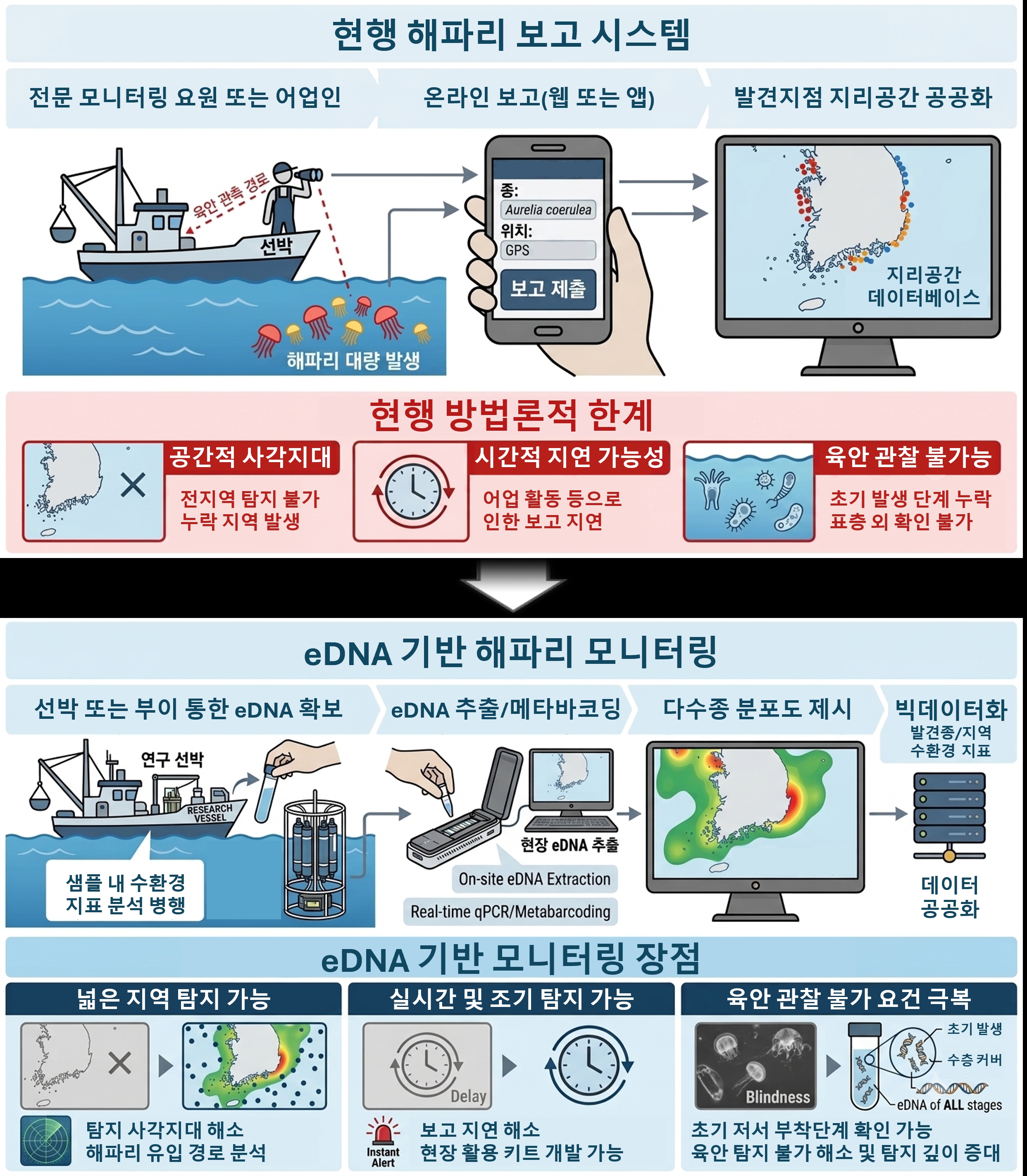
Recently, under the influence of climate change and shifts in marine environments, jellyfish blooms have been occurring frequently in coastal waters of Korea and around the world. In particular, species such as Nemopilema nomurai and Aurelia coerulea cause significant damage to fisheries and pose safety risks to beachgoers, highlighting the growing importance of continuous national monitoring and early forecasting.
In this study, the research team developed a new Cytochrome c oxidase subunit I (COI) gene-based primer to selectively detect jellyfish species and validated its performance by applying it to eDNA samples collected from Korean coastal waters.
The results demonstrated that while the conventional, internationally widely used universal primer detected only one species—the moon jellyfish (Aurelia coerulea)—the newly developed primer successfully detected six jellyfish species from a single sampling event. Furthermore, Aurelia limbata and Rhopilema esculentum were additionally detected through eDNA analysis despite not being identified in on-site visual surveys, proving the primer's capability to detect species that are difficult to confirm through traditional survey methods.
Researcher Seong-ah Kim stated, "Currently, domestic jellyfish surveillance relies primarily on visual surveys and field sampling, which have limitations in detecting jellyfish during early emergence stages or when population density is low. The jellyfish-specific primer developed in this study can detect various jellyfish species with high accuracy using only trace amounts of eDNA present in seawater, which is expected to advance early warning systems for jellyfish blooms."
She added, "Recently, domestic research institutes including the National Institute of Fisheries Science have been actively developing eDNA-based marine organism monitoring technologies. The primer developed in this study is expected to serve as a foundational technology that can be linked with national jellyfish monitoring projects to enable more accurate species identification and early prediction."
By presenting a molecular ecological tool capable of effectively detecting jellyfish species that were difficult to identify using existing universal DNA analysis methods, this research is expected to provide an important scientific basis for monitoring jellyfish outbreaks caused by climate change, managing marine ecosystems, mitigating fisheries damage, and enhancing national marine environment surveillance systems.
The research findings were published in Scientific Reports (IF: 4.9), an international peer-reviewed journal published by Nature Portfolio.
- attached file
- There are no attachments.